

CDX Plywood vs. OSB: What’s Best for Roof Sheathing?
March 26, 2026
•
Written By
Roofscape
.png)
If you've ever stood in the lumber aisle staring at two nearly identical-looking sheets of wood wondering what the difference is, you're not alone. CDX plywood and OSB — oriented strand board — are the two most common materials used for roof sheathing, and the debate between them has been going on in the construction world for a long time.
Here's the thing: both materials work. Both are code-approved. Both are installed on roofs every single day across the country. But they are not the same, and the differences between them matter more than most homeowners realize. Whether you're replacing your roof deck after storm damage, building new construction, or just trying to have an informed conversation with your contractor, this guide will get you there.
Key Takeaways
- CDX plywood and OSB are both widely used for roof sheathing, but they perform differently in wet conditions.
- OSB is typically less expensive and more uniform in thickness, making it popular in new construction.
- CDX plywood tends to handle moisture better and is often preferred in high-humidity or rain-prone climates.
- The right choice depends on your climate, budget, roof design, and how the sheathing will be protected.
- A knowledgeable local roofing contractor can tell you exactly what makes sense for your home and your region.
What is roof sheathing and why does it matter so much?
Roof sheathing is the structural layer that holds your entire roofing system together.
Before we get into the CDX vs. OSB debate, it helps to understand what sheathing actually does. It's the flat panel material nailed across your roof rafters or trusses. Everything else — your underlayment, your shingles or metal panels, your flashing — sits on top of it. Sheathing ties your roof frame together, distributes load across the structure, and gives your roofing material something solid to fasten to.
When sheathing fails, the whole system above it is compromised. Soft spots, sagging, and fastener pull-through are all signs of sheathing that's worn out or was never right for the job. Getting this layer right isn't optional. It's foundational.
What exactly is CDX plywood and what makes it different?
CDX plywood is a layered wood panel built for structural use in exposed conditions.
The name tells you a lot. CDX plywood is made of multiple thin wood veneers glued together with each layer's grain running perpendicular to the next. That cross-grain construction is what gives plywood its strength and stability. The "C" and "D" refer to the grades of the two face veneers — C-grade on one side, D-grade on the other, both of which allow for some natural imperfections. The "X" stands for exterior-grade glue, meaning the adhesive holding those layers together is designed to hold up when moisture gets involved.
That exterior glue is a big deal. When CDX plywood gets wet, it may swell at the edges or warp temporarily, but it generally dries back close to its original shape without delaminating. For a material that's going to live under a roof for decades, that kind of resilience is worth paying attention to.
What is OSB and why has it taken over so much of the market?
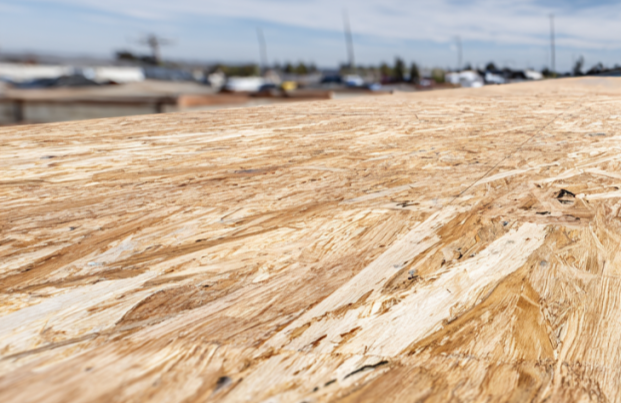
OSB is an engineered wood panel made from compressed wood strands, and it dominates new construction for good reason.
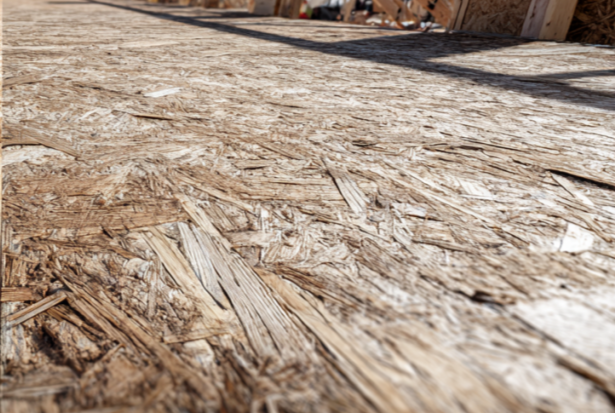
Oriented strand board is made by taking small wood strands, orienting them in specific directions, and bonding them together under heat and pressure with waterproof resin. The result is a dense, consistent panel that performs well structurally and costs less to produce than plywood.
OSB took over the residential construction market largely because of price and consistency. There's no grain variation, no knots, and no voids — every sheet is uniform from edge to edge. Builders love that predictability. OSB is also produced from smaller, faster-growing trees, which makes it a more efficient use of timber overall.
The trade-off shows up when OSB gets wet. Unlike plywood, OSB doesn't dry back to its original dimensions as reliably. The edges especially tend to swell and stay swollen. On a properly installed, well-protected roof this rarely becomes a problem. But in climates with heavy rainfall, high humidity, or during a long construction window with the roof exposed, that vulnerability is worth knowing about.
How do CDX plywood and OSB compare when it comes to moisture and weather?
In wet or humid climates, CDX plywood generally holds up better over the long haul.
This is where the two materials separate most clearly. Here's a side-by-side look at how they handle the conditions that matter most on a roof:
- CDX plywood resists edge swelling better and is more likely to return to shape after drying out.
- OSB is more vulnerable to prolonged moisture exposure, particularly at the cut edges and corners.
- Both materials should be covered with underlayment quickly during installation to limit weather exposure.
- In consistently dry climates, OSB performs nearly as well as plywood and the cost savings are significant.
- In coastal, humid, or high-rainfall regions, many experienced contractors still reach for plywood without hesitation.
- Proper ventilation in your attic extends the life of either material by keeping moisture levels in check year-round.
The bottom line: where you live should influence what goes on your roof deck.
Which material costs more, and is the price difference actually worth it?
CDX plywood typically costs more per sheet, but the gap has narrowed and the value depends on your situation.
For years, OSB was significantly cheaper than plywood — often 20 to 30 percent less per sheet. That gap has narrowed as lumber prices have shifted, but CDX plywood still tends to run a bit higher. On a full roof replacement, that difference can add up to several hundred dollars depending on the size of your home.
Whether that's worth it comes down to where you're building and how long you plan to stay. If you're in a dry climate and the roof will be dried in quickly, OSB is a perfectly solid choice and the savings are real. If you're in a region where rain is frequent, humidity is high, or if your build timeline stretches across a wet season, spending a little more on CDX plywood is a form of insurance that often pays for itself.
The Roof Deck Files: Questions We Hear All the Time
Does the type of sheathing affect which roofing material I can use?
Not significantly. Both CDX plywood and OSB are compatible with asphalt shingles, metal roofing, tile, and most other common roofing systems. What matters more is the thickness of the panel, which is determined by your rafter or truss spacing. Your contractor will spec the right thickness for your framing layout.
How thick should roof sheathing be?
For most residential roofs with rafters or trusses spaced 24 inches on center, 7/16-inch OSB or 1/2-inch CDX plywood is standard. Wider spacing or heavier roofing materials may call for 5/8-inch panels. This is something your contractor and local building code will dictate, so don't guess on this one.
Can I replace OSB sheathing with plywood when re-roofing?
Yes, and some homeowners choose to do exactly that — especially if the existing OSB has edge swelling, soft spots, or moisture damage. A full re-roof is the right time to evaluate what's underneath and upgrade if it makes sense for your climate and long-term plans.
How do I know if my current roof sheathing needs to be replaced?
Signs of failing sheathing include visible soft spots when walking the roof, sagging between rafters, shingles that seem to wave or buckle, and fasteners that don't hold cleanly. During a roof replacement, a good contractor will inspect the deck and flag any sections that need to come out before new material goes down.
Let's Put the Right Foundation Under Your Roof.
Roof sheathing isn't the most exciting topic in home improvement — but it might be the most important layer nobody talks about. Get it right and everything above it performs the way it should for decades. Get it wrong and you'll be dealing with the consequences long before your roof should need attention.
If you're in Cumming, GA or the surrounding areas and you want a roofing team that takes the whole system seriously — from the deck up — Roofscape is ready to help. They bring honest assessments, quality materials, and the kind of craftsmanship that holds up long after the crew pulls away.
Reach out to Roofscape today and find out what your roof deck really needs.
Recent Articles

Residential Roofing
How to Repair a TPO Roof: DIY Tips for Flat Roof Fixes
Regular inspection and roof repair are best things to do to extend the life of a TPO roof. When in doubt, a professional assessment costs far less than the water damage that follows a failed repair.
March 27, 2026
CDX Plywood vs. OSB: What’s Best for Roof Sheathing?
CDX plywood vs. OSB: compare cost, moisture resistance, durability, and performance. Learn which roof sheathing is best for your climate, budget, and long-term roofing needs.
March 26, 2026

Residential Roofing
What Are Roof Scuppers? A Guide to Flat Roof Drainage
Most people have heard of gutters and downspouts. Far fewer have heard of roof scuppers, on a flat roof scuppers might be doing more work to protect your building than any other single component.
March 20, 2026
Rafters vs. Trusses: Which Roof Framing Is Best for Your Build?
Rafters vs. trusses: compare cost, design flexibility, installation speed, and attic space. Learn which roof framing system fits your build, budget, and long-term goals.
March 19, 2026